Husbandry, the extremely serious way
Corn Snake Care Guide
So you want a corn snake. Good choice. They're the golden retrievers of the snake world — if golden retrievers were four feet long, had no legs, and ate mice. Here's everything you actually need to know.
The snake itself
Corn snakes are nonvenomous and native to the southeastern US — my home turf. Florida knows what's up. Adults run 3 to 5 feet long. They're crepuscular, which means they're most active around dawn and dusk, basically the same schedule as everyone with a day job. With good care they live 15 to 25 years. This is a decades-long commitment, not a phase. Plan accordingly.
Housing: the 40-gallon rule
My minimum for an adult corn snake is 40 gallons. Bigger is always better — they'll use every inch you give them, especially vertical space, because corn snakes love to climb. But 40 is the floor. Don't go smaller, and don't let anyone tell you a 20-gallon works for life. It doesn't.
Front-opening enclosures are the move: more secure, easier to get into, hold heat and humidity better. If you go with a glass tank, black out three of the four walls so your snake feels hidden, and clamp that lid down like its life depends on it — because corn snakes are escape artists. Paranoia is your friend. And never use tape inside the enclosure. Ever.
Set it up with at least two hides (one on the warm side, one on the cool side), a sturdy branch or two for climbing, and a water bowl big enough to soak in. They will soak. It's fine.
One snake per enclosure. They're not social. They don't get lonely. They don't need a roommate.
Heating and lighting
Corn snakes are cold-blooded, so you're their heat source now. I run under-tank heat — a heat mat under one side of the enclosure, holding the surface at 84–88°F. That's the warm side, their basking zone.
Non-negotiable: put it on a thermostat. Unregulated heat mats cook snakes. That's not a metaphor.
Keep the gradient: warm side 84–88°F at the surface, cool side 75–82°F, so the snake can pick its comfort zone. Nighttime, room temp is fine down to about 75°F.
Lights on 12 hours a day. A low-level UVB over the warm side does them good. Skip the colored "night" bulbs — they mess with the snake's day/night cycle and they're a waste of money.
Set the whole enclosure up at least a week before the snake arrives. Dial it in first, snake second.
Humidity: 65–75%
A lot of care sheets say 40–60%. They're wrong — wild corn snakes live in humid country. Aim for 65–75%. Use moisture-holding substrate (not aspen), a big water bowl, and mist when you need to. Get a digital hygrometer with a probe, not one of those stick-on dials. Those things lie.
Feeding
Corn snakes eat whole prey — mice, and small rats as they grow. Frozen/thawed is the way: safer for the snake, and you don't have to watch a live mouse fight for its life in your living room. Thaw in the fridge overnight, then warm it to about 100°F in warm water right before serving.
How often:
- Hatchlings: every 5–7 days
- Juveniles: every 7–10 days
- Subadults: every 10–12 days
- Adults: every 14–21 days
Prey should be 1 to 1.5 times the width of the snake's body at its widest point. When in doubt, go smaller. An overweight snake is a husbandry problem, not a cute snake.
Feed inside the enclosure — "cage aggression" is a myth. Just tap-train: tap gently with a paper towel roll or stroke with a hook before handling, so they learn the difference between food time and hangout time.
Keep fresh water available at all times and change it daily. Regular tap water is fine.
Handling
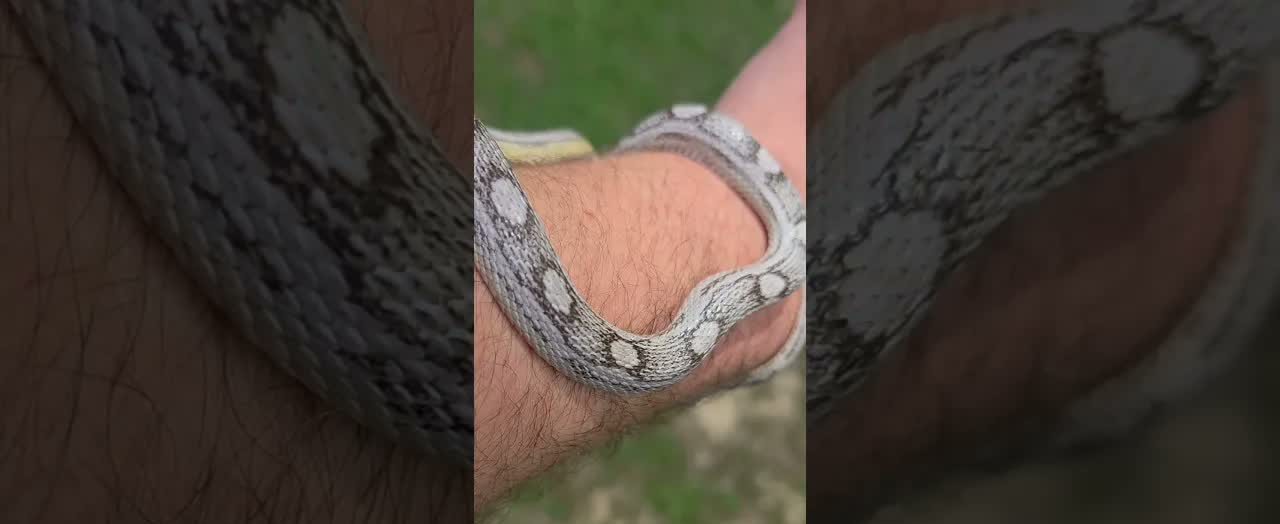
Wait about two weeks after bringing your snake home, and don't start handling until it's eating regularly. Then start slow — five-minute sessions, working up from there. A couple times a week at minimum, once a day at most.
Pick them up from the side, support as much of the body as you can, and don't grab the tail or pin the head. They'll try to climb your arms, your shoulders, your glasses. Let them explore.
Two hard rules: don't handle for 48 hours after a meal (regurgitation can seriously harm them), and don't handle when their eyes go cloudy blue (they're about to shed and can't see — they'll be jumpy). Respect the mood. If they're cranky, put them back.
Will it bite? Anything with a mouth can bite. A baby corn snake bite feels like nothing. Adult bites aren't serious either. If one latches on, don't yank — you'll rip its teeth out. Run some cool water over its head and it'll let go.
Body language cheat sheet
- Tongue flicking: smelling the air, awake and curious. Good sign.
- Head pulled back in an S-coil: feels threatened. Back off.
- Hissing: "go away." Listen to the snake.
- Tail rattling: trying to scare you. It's about as effective as you'd expect from an animal with no legs.
- Musking: you scared the poo out of it. Literally. Congratulations.
- Cloudy blue eyes: shedding soon. Leave it alone.
Care standards adapted from ReptiFiles' corn snake guide, rewritten the extremely serious way.